on Nima Esmailpour’s Date-Painting

NimaEsmailpour Revolution
Date-painting by NimaEsmailpour

Date-painting, an exhibition of Painting/Installation by Nima Esmailpour just opened last Friday, Jan 22nd 2010. The 2nd show of  the brand new  Mohsen Gallery is dedicated to a young artist,  1985 born  Nima Esmailpour previously collaborated with parkingallery in International Roaming Biennial of Tehran and in Limited Access II. You can catch the artist, performing in one of the rooms from 23rd to 25th of Jan.

The catalog of the exhibition features a text  by Omid Mehregan in the ocassion of the exhibition, he will speak to public on Monday 25th Jan. 5pm. The Exhibition will be on view till 27th of Jan and bisting hours are from 4-8.
If you wanna get there, without a car, might have to walk  for a while in the rich Tehrani zafar destrict, starting from Modaress  Zafar Juction. here is a hint to a shortcut instead of  walking in to Dastgerdi (Zafar) St. walk along the Moaddress Highway  eastern sidewalk toward south and without giving yourself a hard time you will find a narrow alley which lead you to Eastern Mina Street and Number is 42 and by now you can see the yellow sign of the gallery on your right and ther you are. You can have a drink and maybe a snack in the small cafe teria located in the backyard,after seeing some art, Enjoy! Continue reading on Nima Esmailpour’s Date-Painting

Best wishes from Parkingallery for 2010

Isolation Glove by Majid Asiabi

Parkingallery wishes you a successful year ahead, We hope that this year will be a great year for Iranian Contemporary arts too, and the curators who visit Iran take off the isolation gloves/glasses from their eyes … Here is an artwork by a young graphic designer Majid Asiabi, who is based in tabriz and we recently came across his works while surfing internet, and we hope collaborate with him in the future.

LIMITED ACCESS II Catalog: Download it in PDF!

LIMITED ACCESS II ‘s catalog now is available to to download in PDF format

We are really thankful to our fabulous designers at NewBookz Studio,
Sam Keshmiri
(Cover(s) and Poster) and Shahab Tondar (Book Design)
who created this wonderful book in the occasion of the exhibition.

Limited Access II catalog is sponsored by Parkingallery and Mooweex.com and published by NewBookz
in 82 Pages, sized 14 x 21 cm and in black & white, with the Edition of 400,in November 2009.

Enjoy!

on Melika Shafahi’s Photographs

Obtuse Meaning and An Economy of Excess:
Reading (in) Detail in Melika Shafahi’s Photographs

Foad Torshizi *

“This text has been originally written to accompany the present series by Melika Shafahi published in Gwangju Biennale’s catalog and is reproduced in parkingallery.com with the permission of the author. It cannot be copied, reproduced, or used in any way without the author’s permission. Please do not cite or circulate this reproduction.”

The series of untitled staged photographs by Melika Shafahi, with their painstaking attentiveness to costume design and makeup, present an atmosphere that mimics the very mechanisms deployed in fashion photography to fabricate desire and perpetuate commodity culture. These strategies of mimicry involve highlighting sculpted bodies, glamorous costumes, and makeup in order to produce conventional ideals of physical and sartorial beauty. However, Shafahi’s imitation of fashion photography does not suggest her desire to attain the status of this genre. Instead, through the use of trivial visual elements that are vexingly out of place (e.g. a ketchup bottle or a propane container), her photographs provoke a feeling of incongruity with conventional standards of fashion. In this sense, her photographs exemplify John Tagg’s broader observation about photography and meaning: “[…] the picture is always too little or too large—obdurately saying less than is wanted and more than is wished” (Tagg, 2009: xxxvi). Melika Shafahi’s photographs fail to fully emulate fashion photography, but it is precisely in this failure, which I call intentional, that her photographs say “more than is wished” in fashion photography. Shafahi’s untitled series, leaves an unsewn tear on its own fabric, which she playfully protects them from seamlessness and finish that are vital to fashion photography.

These tears, however, only appear when we read these pictures intimately, only when we read them up-close, when we physically remove the space between these two-dimensional objects and us in order to build a passionate relationship between our bodies and the photographs. It is only through this physically intimate relation that our eyes are opened to her photographs’ intentional failure as fashion photography and its rubric of enforced perfection. The proximity of our bodies to the photographs also grants us an ability to read intimately, to read in detail. The significance of an intimate reading of details is not only limited to the value of methodological heterogeneity that affords us a perspective that openly accepts the tendency in photography to slip away from the hands of disciplinary knowledge production, but also leads us to a diverse economy of marginal implications, often violently obscured by the predominance of a single central meaning. Naomi Schor, the American literary critic and theorist, writes that photographic detail, as discussed by Roland Barthes, “is marked […] by its participation in an economy of excess. It always enjoys the status of supplement, a luxurious extra. […] the detail which draws and holds Barthes’ attention is like the fetishist’s fetish, a detail which, camouflaged by its perfect banality, goes unnoticed by others” (Schor, 1987: 91).

It strikes me how the terms camouflage and fetish in the statement by Schor resonate with the visuals in Shafahi’s untitleds.

It is only through these minuscule details that we can foster an engagement with her photographs that allows us to change our perspective and let her work become something different. These details, however minute, perform effectively enough to be able to create anomalies: an uncomfortable toe, hiding under the sharp edges of a coffee table; a propane container, a hose attached to it, and an unlit rope creating an accidental and unintended shape on the ground; a plastic ketchup bottle; and finally, a nettlesome shadow on the walls of a decaying background, all of which emerge as a menace to fashion’s obsession with perfection. This supplementary, decentered, and marginal economy of excess serves as our very luxurious clues to interpret one significant meaning of her work: a deliberate failure to pass for fashion photography. Although her models might easily appear in Vogue or in Harper’s Bazaar, she playfully creates these anomalies in order to tell us that her photographs will not fit. Shafahi leaves us hints to realize that her work is never enough or as Tagg puts it is “obdurately saying less than is wanted”; that it never fulfills our desire to articulate its meaning; that it does not allow us to identify the photographs as fashion photography; and that they slip, no matter how hard we try to grasp them.

Then there is another playful failure: Shafahi fails to meet the vexing standards and expectations of Middle Eastern artists. She is an Iranian artist living in France: a wonderful combination that fits into disturbing categorizations of Western galleries and museums, hysterically hunting for any work that will echo a problematic vocabulary comprised of terms such as the Middle East, female artist, exile, the Diaspora, plight of women and so forth. But her work does not exhibit the famous dark veil, nor does it perpetuate the stereotype of victimized and voiceless Iranian women. The tenuous, though intentional and self-reflexive, Persian calligraphic inscription on the bodies of her models speaks to this failure. She oscillates between gestures of exoticization and expressions of envy for a mode of representation, from which Iranian women have been excluded from via a homogenizing force that camouflages them under the dark veil. Notwithstanding the latent possibilities to be misconstrued as either, she deliberately fails to present any of them. But she does not fail to remind us, obstinately, of our own failure to pin down “the meaning” in her works. She leaves us subtle inklings to the tension at the heart of the failed pursuit of the subjectivities constructed in her photographs and to fit into a Western subject position that creates, consumes, and controls fashion. It is through this obscure meaning that Shafahi’s works surpass the limits of fashion photography, dismantle its desire machine, unsettle the very mechanisms of fabrication of subjectivity, and perform effectively as a critique of identity politics in the time of a globalized world.

*Foad Torshizi is a doctoral student of Art History at the University of Minnesota, Twin Cities.

Limited Access II at Azad Gallery Tehran

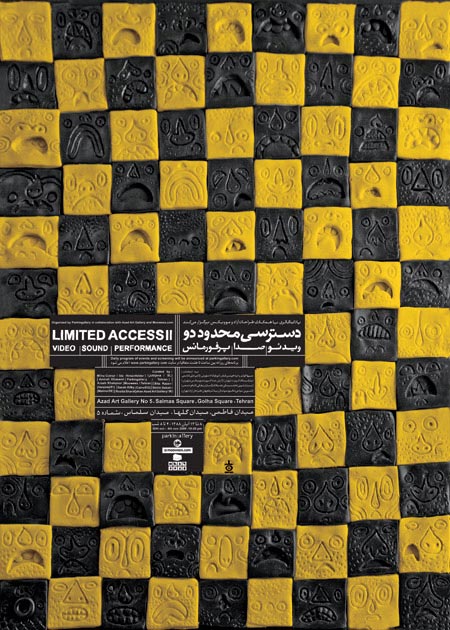
LIMITED ACCESS II

VIDEO | SOUND | PERFORMANCE

Organized by Parkingallery in collaboration with Azad Art Gallery and Mooweex.com

Azad Art Gallery No 5, Salmas Square, Golha Square, Tehran
31 October – 4 November 2009
Daily Visiting Hours: Fri – Wed 4-8 pm
Opening night and performances: Friday 30 October, 4-8 pm

Curated by
Miha Colner / Ida Hirsenfelder (Ljubljana/SL) | Amirali Ghasemi (Parkingallery/Tehran) | Arash Khakpour (Mooweex/Tehran) | Bita Razavi (Helsinki/FI) |Sarah Rifky (Cairo/EG) | Shirin Sabahi (Malmo/SE) | Rozita Sharafjahan (Azad Art Gallery/IR)

Access to what? What limitations?

LIMITED ACCESS sounds like a disappointing title for a project, but in fact it’s not really true, it has a kind of ambiguity within it, which is a characteristic of Parkingallery projects. One should ask : “Access to what?” and “What limitations?”
In the past decade, Iranian Contemporary art and specially New Media Arts has been through many ups and downs, either in the time which was temporarily celebrated by the authorities and officials, by a considerable budget and space, without necessarily establishing a constant and appropriate structure for its survival in future, or when it visibly slowed down its development at least outside of the unofficial and private circles of artists in the recent years. And as we speak the numbers of curators and art lovers who are frequently visiting Tehran, for various reasons and intentions is highly increasing, specially now when the international Media zoomed more than ever, on Iran. The Art Market despite recent hiccups is heating up by its discoveries of middle eastern and Iranian art shows from LA to Dubai, filled with repetitive names of superstars. Meanwhile there is an independent creative scene which is emerging and is undoubtedly hard to track and describe, as its vibrancy and its continuity lies in its anonymity. In the absence of  an inclusive reference for a proper research on multi fragmented Tehran art scene, most of the attempts which has been done to map and document the scene, remained unfinished and to some degree clueless because of the intentional shifts toward the art market and/or falling into the traps of tribal self promotional concerns of few.

LIMITED ACCESS therefore tries to gather and reconnect the artists from all disciplines to each other and reestablish their link with their emerging audience. As we believe that what is labeled and being marketed as “Iranian contemporary art” to the art world is quite known and accessible despite all propaganda, as many individuals and collectives are paying their dues for its exposure and growth internationally, even by conflicting objectives and means. What is really missing here is a local platform, which though its structure, experiments in New Media can be seen and discussed , beyond the closed circle of the artists practicing it.
As delayed echos  of such phenomenon, often passing through mediums like Internet, books and other medias might turn the viewer into a passive consumer rather than a critical observer.

These limitations could be caused by many factors, from the imposed sanctions to unofficial boycotts, to the emergence of market-oriented attitude among artists as a result of periodic temporary reception of Iranian art all around the world, beside as some other may put it, the fact that contemporary art is being rarely mentioned in the mainstream media, ignored to some extent and not supported any more.  All these excuses are not enough to prevent us from taking the current moment for granted even if it would seem hopeless to many, and shape the future by observing and learning from it.

Amirali Ghasemi, Parkingallery Oct 2009

Jazire-ye Sargardani (The Wander Island)

(Video screening, Interactive installations and a collection of experimental Sound and music )
Curated by Amirali Ghasemi

Amin Talachian | Ronak Ghoseyri | Sara Abbasian | Negar Behbahani | Ehsan Behmanesh/ Arefeh Riahi | Ali Ettehad | Ayeh Rahimi | Amirali Mohebbinejad |  AR2+ ISIS | Arash Fayez | Nassrin Nasser | Elika Hedayat | Arash Khakpour/ Arash Radkiya | Amirali Navaee | Bijan Moosavi | Pedram Etemadi | Siavash Naghasbandi | Sona Safaei | Tala Madani | Azin Feizabadi | Sohrab Mostafavi Kashani | Mohammad Abbasi | Peyman Abbasian | Sohrab. M Kashani | Arash Salehi /Arash Razzazian | Nima Esmailpour |

Videos selected by Rozita Sharafjahan (Azad Art Gallery/IR)
Khosro Khosravi | Behnam Kamrani | Hamed Sahihi | Ghazaleh Hedayat | Samira Eskandarifar | Mohsen Rasoulov | Minou Iranpour | Setareh Jabbari | Elham Doust Haghighi | Farid Jafari Samarghandi

8513 hours in Helsinki

Curated by Bita Razavi

Eija-Liisa Ahtila | Sara Pfrommer | Katarzyna Miron | Stefan Riebel | Joonas Jokiranta | Maria Ylikoski | Linda Reif | Stefan Riebel | Gregoire Rousseau | Miina Hujala | Anna Nykyri | Hanna Marno and Leena Vahvelainen | Ewa Gorzna | Teemu Kivikangas

(one)self as (an)other

Curated by Sarah Rifky (Cairo/EG)

Sherif Elbendary | Hassan Khan | Mohamed Allam | Mohamed Nabil | Shady El Noshokaty | Hossam Elsawah | Laila Sami

Intelligent Systems

(installations / video / multimedia / documentation)
Curated by Miha Colner / Ida Hirsenfelder

Tanja Vujinovic | Maja Smrekar | Robertina Sebjanic | Borut Savski | Lada Cerar & Saso Sedlacek | Vladimir Ristic | son:DA & Erinc SeymenTomaz Furlan | Neven Korda | Saso Podgorsek | Marko Kovacic & Kolja Saksida | Ana Sluga | Jaka Zelelznikar

Whoever I Like Turns out to be a Weirdo, or Performative Narrations

(video screening)
Curated by Shirin Sabahi

Kevin Murphy | Tamar Guimarães | EllaKajsa Nordström | Henning Lundkuist | Stine Ofelia Kildevang | João Leonardo | Annette Stav Johansson | Maj Hasager | Wattanai Chanakot | Ana Bezelga | Kristina Kvalvik | Maria Lusitano Santos | Hanna Paulin | Hanna Sjöstrand | Lara Morais

Fires in Forests

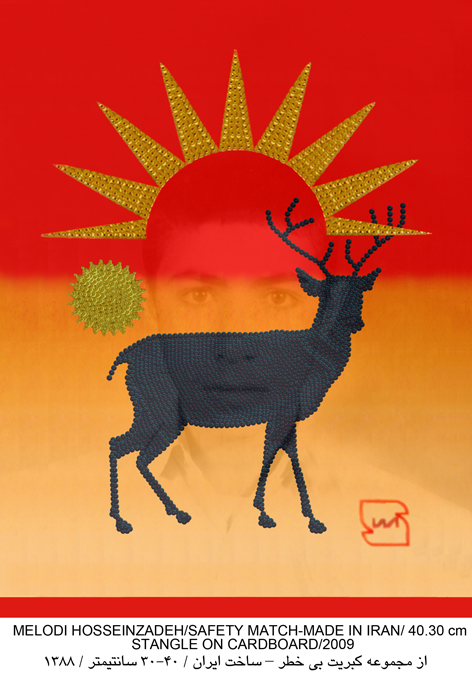
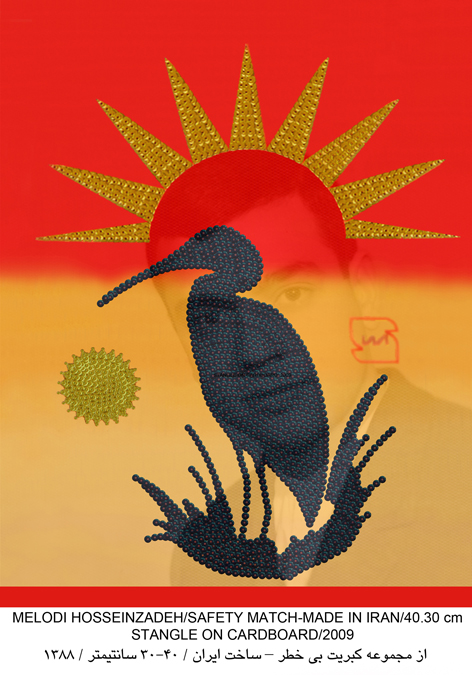
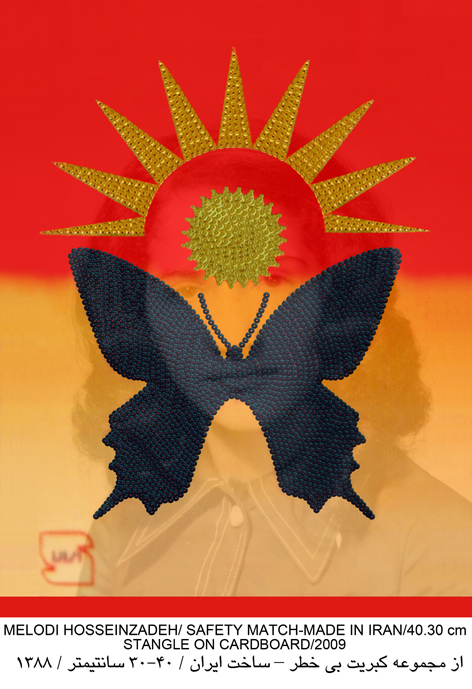
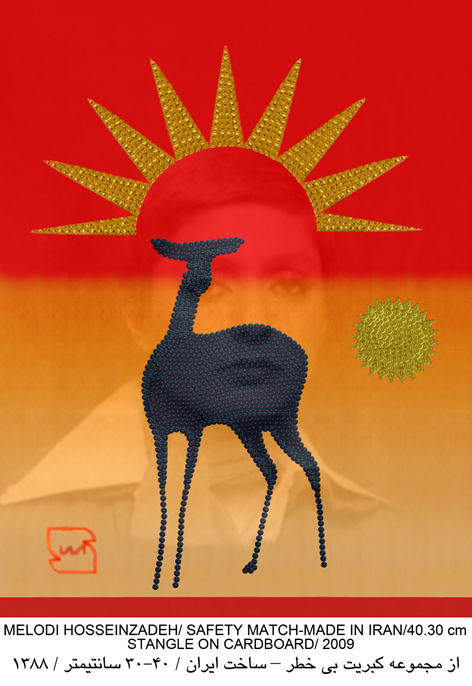
a note on Melodie Hosseinzadeh’s exhibition in Azad Art Gallery, Tehran
by Bavand Behpoor

Tavakkoli Matches Co. annually produces 10 billion matchboxes with 300 workers. Each ordinary Tavakkoli matchbox contains 40 matchsticks. Tavakkoli Matches Co. annually produces 400 billion safety matches. Considering the fact that the company was established in Iran in 1917 at the end of the First World War and has been active for more than 90 years, it has produces thousands of billion safety matchsticks till now.

Tavakkoli Matches Co. can provide each living human being with 60 safety matchsticks per year.

On Wed. 29th July 2009 at 10:37 am Rasekhoon website affiliated with ‘Religious Donations Charity Organization’ reported under the title of ‘We have the Biggest Match Producing Company in the World’ quoting ‘Green Family Magazine’: ‘Today lighters have replaced matches. Large matchstick producing companies each produce certain kind of matches. One produces fantasy matchsticks, the other fireplace matches, etc. But Tavakkoli Matches Co. is the only factory in the world that produces all these products. Mr Tavakkoli says, “Nowadays each matchbox is sold for two dollars while Tavakkoli matches are sold for only 50 cents” and he adds with much pride that, “we are the largest most efficient and influencial producer in the world”.’

On Tavakkoli matchboxes is either a picture of an animal or an advertisement. The animals portrayed on boxes are different in kind and have iconic quality. Tavakkoli matches are a standard of our culture.

On the other side of matchboxes, Tavakkoli Matches Co. congratulates the victory of Islamic revolution on 11th Feb. to the consumers. Since the matches are used throughout the year, it congratulates the victory all yearlong and the consumers think of it when they light the matchsticks.

Matches produced after 1844 are called safety matches, for early matches contained white phosphorus dangerous both to producers and consumers and would afflicted them with phossy jaw or other bone disorders. At that time, the amount of white phosphorus in one box was enough for killing a human being.

Tavakkoli matches have been used throughout Iranian history for firing Reza Shah’s cannons, lighting Molotov cocktails, burning cinema screens, lighting cigarettes of soldiers, drug addicts and those sentenced to death, for setting oneself on fire, for lighting fire in forests, for setting cats on fire, for allowing kids entertain themselves during long afternoons, for lighting alcoholic lamps or setting garbage cans on fire. As such, it is no doubt the symbol of our national identity. Matchsticks are made of pinewood and their so-called sulfur is made of a mixture of 12 chemical elements attached to the stick with animal silicone.

The last point you need to know in order to enjoy the exhibition is some acquaintance with Vogue magazine and the art of illumination.

The Dada Disgust: A Medical Profile*

As Doctor Prescribed by Amirali Ghasemi and Hamed Sahihi | 2009 |
Vocals: Nazli Bodaghi | Sound recording: Soheil Peyghambari |
Recorded at Kargadan Studio | Music by: Martin Shamounpour

The Dada Disgust: A Medical Profile*
Bavand Behpoor
27 July 2009

‘…[C]ruel with myself… .’
—Antonin Artaud

‘The exhibition is disgusting’, visitors would say. ‘And it is probably the most powerful thing he has ever done,’ they would add. [Of course, he hadn’t done it. It had been done to him, or, in certain cases, he had himself exposed to it.] To make it short: there was no doubt that Amir Ali Ghasemi’s exhibition at Azad Art Gallery was powerfully disgusting.
As a visitor, I personally take no pleasure in being disgusted. Generally, what I expect from artistic encounter is not so much about ‘being moved’, rather about seeing a clever ‘move’ on behalf of the artist. There would have been little sense, and probably even less art, in ‘AmirAli’s Medical Profile’ if it was less clever than moving.
The exhibition, in most part, simply documents the medical history of the artist in an objective manner. This is done with a scientific accuracy endowing the work with a solemn bitterness. No matter how much self-pity is intermingled, the works raging from videos to photographs, to narrative texts and interactive installations all testify to an ‘objective’ and ‘undeniable’ agony experienced through the processes they portray. They range from ‘facial irritations caused by being exposed to sever air pollution and floating dust’ to a picture of a broken left tumb to a Salbutamol spray to ‘nine metal objects in platinum including one main part with nine holes and eight screws installed on the right leg’s bone during 1993-4’ to ‘wounds and irritations on the left art caused by reactions to smoking and consuming hot potato chips, 16 July 2009’ and the like. The presentation of the works is sincere but careful and well thought of. The interactive shelves filled with objects considered irritating or disgusting to the artist, do not qualify for a kind ‘presentation’, they ‘perform’.
As a kind of self-portraiture and at least on the surface, the work is far from being narcissist. The artist happily engages in a brutal destruction of a social image we normally expect to be ‘healthy’, ‘lively’ and ‘coherent’. But fortunately, this is not what the work is all about: it does not try to seek compassion as documentary or journalistic photography might do: there is nothing to be done about what is portrayed. There is nobody to blame but life. All that is gathered in this one person could have happened separately to anyone of us. And it actually has. It is not a call for help: in certain cases, the artist has voluntarily exposed himself to a risk, turning photographs into documents of performances, which, instead of probing the limits of physical tolerance, portray the excessive vulnerability of ‘this’ single body.
While nothing is fictional here, the narrative texts documenting the events are extremely performative.  The artist considers them not only a part of the exhibition, but rather an end to it, ‘I wanted to write them, so I made up this exhibition.’ While attempting in their way of writing to portray the harshness of a situation, they carefully limit themselves to the medical history they narrate. They contend themselves in saying, ‘it happened and it was so bad’ but all the same, they convey there is something very inhumane about this simple and apparently neutral way of saying it. It is as if the artist/author is addressing a coroner at a court session where every bit of human attention is exchanged with bits of evidence.
All this would have not been so meaningful if presented in a different location and to a different audience: it would have not been the same exhibition outside Tehran and Azad Art Gallery, an art gallery famous for its courageous management which dares to host most politically charged contemporary art exhibitions of today’s Iranian art scene. It is in this troubled city with a boiling political atmosphere that the true meaning of the exhibition unfolds: it is not a work of someone like Paul McCarthy, a master of disgust, humiliating the healthy-wealthy modern subject of a consumerist capitalist society, quite the contrary, it is an exposition of sheer vulnerability of a human body that only finds the freedom of criticizing infliction of pain upon bodies when it is presented in a greater generality. Thus, it is not an exhibition only about ‘now’ and ‘here’: it is about thirty years of history that the artist and his generation have experienced which has left them alone with a sort of ‘dada disgust’. It is about a ‘wrong life that cannot be lived correctly’, as Adorno would have had it, which we tried to live.
So there it is, a powerfully disgusting exhibition nurturing on an urge probably located at the intersection of Artaud and Rimbaud: trying to be cruel to one’s self in portraying himself while at the same time implicity stating that ‘I is the Other’.
* ‘Amir Ali’s Medical Profile’ was held at Azad Art Gallery, Tehran, from 24th till 29th July 2009. Further info and images of the work can be found at www.azadartgalery.com and the artist’s personal website:
http://www.amiralighasemi.com/

Born From The Ashes

Parkingallery strikes back

Parkingallery is changing from an E- gallery/ nice looking static website to a multifunctional blog / news portal on Iranian and international contemporary arts and design… this decision has been made through around a year of less frequent activities on our website focusing on other projects including the our monumental mega exhibition in a suitcase: URBAN JEALOUSY/The roaming biennial of Tehran . There are other reasons to shift our activities from plain showcasing up and coming artists to a more advanced way of paying our due to the community of Iranian involved with arts, to name a few:

1st of all because of  the fact that the way we Iranians are dealing with Internet phenomenon and its fabulous growth in Iran despite obstacles raining from everywhere (!), we are encouraging our artists friends to setup their own personal websites and try our best to help them both as design studio and a project space to promote and maintain their website while benefit from being linked and featured in our refreshed website.

Secondly despite we’ve never have been acting as a commercial gallery, an increasing numbers of the artists used to work with us did or about to sign restricting contracts with individual, institutions and galleries,which made us think to refresh what we has been showing on our website for over a decade, to be experimental  and less conventional and more and more away from sophisticated mainstream trends, and more importantly focused on new media art projects and knowledge production it the field of interdisciplinary practices.

we believe that current circumstances forces by various players in the scene  made circulation of the art and its makers and contributors in Iran going through severe unfair issues, caused many talented young artist to be ignored to to fall into early professionalism which kills their interest and reduce their intention for experimental projects and practices, having said that what is really a nessesity of our time is building up an news portal/idea exchange pool which aims to track what’s happening now in the art scene by documenting see-worthy happening and events and what has been through by interviewing the key figures in the field, helping us to discover the lines between the lines of unwritten history of our own! ( wow what a big claim!)

Finally to find practical way to make parkingallery’s archive on contemporary arts, which has been evolving through the years, available online and to public.

To make all this happen, we are looking for contributors from around the world who are interested in the arts and its universe  to join our team and/or help us as freelance reporters and photographers, we will write more about this call, very soon.

That’s all for now…

Warm wishes from Parkingallery’s Headquarter

Parkingallery Team